
Automotive
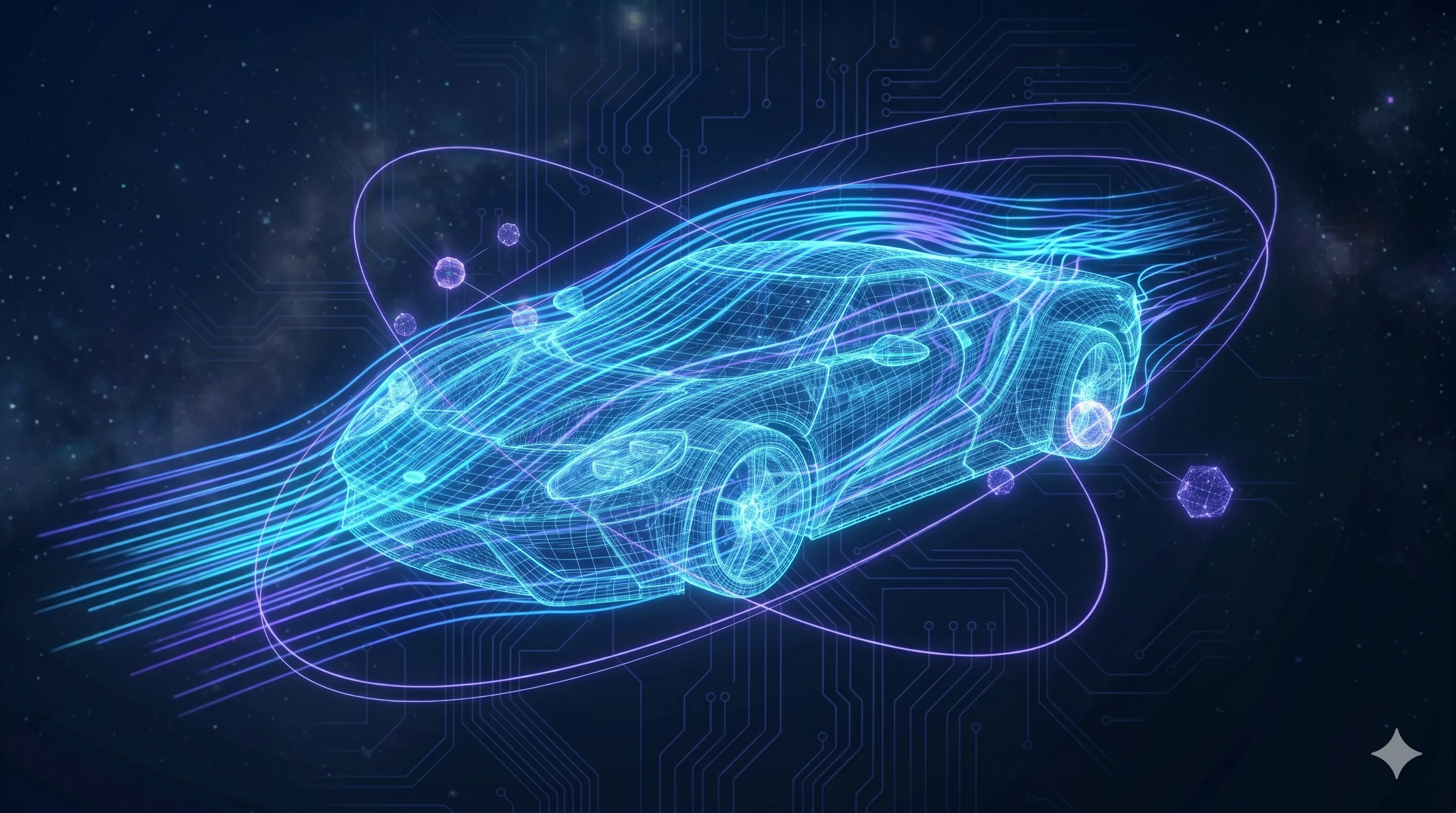
The automotive industry runs on simulation. Every vehicle program — from initial concept to production sign-off — generates thousands of simulation jobs spanning aerodynamics, structural safety, powertrain thermodynamics, and durability. The shift to electric vehicles has added new workload categories: battery pack thermal management, electric motor cooling, and power electronics simulation now sit alongside traditional combustion and crash disciplines. The throughput requirement is not modest. A competitive OEM or tier-1 supplier running active programs simultaneously needs reliable access to hundreds of cores at all times, with peak demand during design-freeze and homologation phases that can exceed that by an order of magnitude.
Key Workloads
Automotive simulation spans multiple physics domains, each with distinct software ecosystems and hardware profiles.
Software Stack and HPC Requirements
| Software | Workload Type | Parallel Scaling | GPU Support | Typical Core Count |
|---|---|---|---|---|
| STAR-CCM+ | External aero, thermal, multi-physics | Very good | Yes | 64–2,048 |
| ANSYS Fluent | External/internal CFD, thermal | Excellent | Yes (GPU solver) | 64–2,048 |
| LS-DYNA | Crash, impact, occupant safety | Very good | Yes | 32–512 |
| Radioss | Crash, NVH, structural | Good | No | 32–256 |
| CONVERGE | In-cylinder combustion CFD | Good | Yes | 16–256 |
| AVL FIRE M | In-cylinder flow, spray, combustion | Good | Limited | 16–128 |
| ANSA / META | Pre/post-processing | Single node | No | 8–32 |
| Abaqus | Structural, fatigue, durability | Good | Limited | 32–256 |
Pre- and post-processing tools (ANSA, META, EnSight, ParaView) run on shared login or dedicated visualization nodes and do not require cluster-level parallelism, but do require high-memory workstations or interactive nodes with fast GPU rendering.
Application Areas
External Aerodynamics
Reducing aerodynamic drag is directly linked to vehicle range for EVs and fuel consumption for ICE vehicles. External aerodynamics CFD with STAR-CCM+ or Fluent uses steady-state RANS for baseline drag coefficient studies and time-accurate RANS or LES for complex separated-flow regions: A-pillar vortices, underbody wake structures, and wheel-well interactions.
A production-quality external aerodynamics simulation for a passenger vehicle typically involves:
| Parameter | Value |
|---|---|
| Surface mesh | 50–150 million cells (including detailed underbody and tire geometry) |
| Core count | 256–1,024 cores |
| Wall-clock time per run | 4–24 hours depending on turbulence model and convergence criteria |
Cooling system CFD — airflow through the front grille, across the radiator and condenser, and through the engine bay — is often coupled with the external aerodynamics model, adding heat exchanger and fan models that increase mesh density and solver complexity further.
Drag coefficient optimization involves many design iterations. Teams running parametric studies — front bumper geometry, side mirror shape, active grille shutter positions — may submit 10–50 jobs per design cycle. Scheduling throughput, not just per-job performance, determines how many design alternatives can be evaluated before freeze.
Crash Safety and NCAP Compliance
Crash simulation is an LS-DYNA-dominated workload in the automotive industry. Euro NCAP and US NCAP protocols require multiple impact configurations: frontal full-width rigid barrier, offset deformable barrier, side pole impact, far-side impact, and pedestrian head and leg impactor tests. Each configuration requires a fully detailed vehicle model — body-in-white, closures, interior trim, occupant, restraint systems — typically containing 3–8 million finite elements and 500–2,000 contact definitions.
A single NCAP crash run at standard 100 ms simulation time, on a 5M-element model, typically requires:
| Parameter | Value |
|---|---|
| CPU cores | 64–128 |
| RAM | 256–512 GB |
| Wall-clock time | 2–6 hours |
Full NCAP protocol compliance requires running all mandatory tests plus developmental variants. A program running 50–200 crash jobs per week needs a dedicated crash cluster or reliable burst capacity. Mevasis provides dedicated LS-DYNA clusters with SLURM job scheduling tuned for short-duration, high-throughput crash workloads.
Pedestrian protection simulation — particularly head impactor trajectories across bonnet surfaces — involves repeated short runs that benefit more from job scheduling efficiency than per-job core count. High-throughput scheduling with fair-share queues is as important as raw cluster size.
EV Battery and Electric Drivetrain Thermal Management
Electric vehicle programs have introduced simulation workloads that did not exist at scale a decade ago:
Battery pack thermal management: Lithium-ion cell thermal models require resolving flow through cooling channels between module rows, often in conjugate heat transfer (CHT) mode coupling solid cell thermal mass with coolant flow. A 100 kWh battery pack model may contain 20–80 million cells. Fast-charge thermal runaway propagation studies add transient complexity and electrochemical coupling.
Electric motor cooling: Oil-spray and water-jacket cooling of permanent magnet synchronous motors (PMSM) involves two-phase flow, rotating geometry (MRF or sliding mesh), and electromagnetic heating sources derived from motor loss maps or co-simulated with electromagnetic solvers.
Power electronics thermal management: Inverter and DC-DC converter cooling — cold plate design, thermal interface material optimization — uses steady-state CHT simulations that are lower complexity but run in large parametric batches.
All EV thermal workloads benefit from GPU-accelerated CFD solvers (STAR-CCM+ GPU, Fluent GPU) due to the fine mesh resolution needed around cooling channels and the volume of parametric variants required.
Engine Combustion CFD
For ICE and hybrid programs still in development, in-cylinder flow and combustion simulation with CONVERGE or AVL FIRE M remains active. CONVERGE’s automatic mesh refinement (AMR) approach is especially effective for capturing flame propagation and spray breakup without manual mesh preparation, but generates variable cell counts per timestep that complicate core allocation. Typical CONVERGE jobs run on 32–128 cores with high-frequency I/O, making fast local scratch storage as important as core count.
Fatigue and durability analysis — road-load data correlation, frequency-domain fatigue, crack growth — runs primarily in Abaqus or MSC Nastran and requires high-memory nodes for large assembly models. These jobs often run overnight and benefit from fair-share scheduling that fills cluster capacity between peak aerodynamics and crash workloads.
Typical HPC Configuration
Automotive HPC Cluster — Reference Architecture
├── Login / Visualization Nodes (2–4×)
│   └── High-RAM workstation-class: 256–512 GB, NVIDIA RTX 6000
│       → ANSA pre-processing, ParaView/EnSight post-processing
├── Aerodynamics / CFD Compute Nodes (32–128 units)
│   └── Dual AMD EPYC 9654 (192 cores/node), 512 GB DDR5
│       → STAR-CCM+, Fluent, CONVERGE
│       → InfiniBand NDR200 per node
├── Crash Compute Nodes (16–64 units)
│   └── Dual AMD EPYC 9554 (128 cores/node), 256 GB DDR5
│       → LS-DYNA MPP; InfiniBand HDR100
├── GPU Nodes (4–16 units)
│   └── 2–4× NVIDIA L40S or H100 per node
│       → STAR-CCM+ GPU, Fluent GPU solver, EV thermal CHT
├── High-Memory Nodes (2–4 units)
│   └── Quad-socket or large-memory EPYC: 1–4 TB DDR5
│       → Abaqus large fatigue models, full-vehicle Nastran
└── Parallel Storage
    └── BeeGFS on NVMe + SAS
        Write bandwidth: 10–30 GB/s aggregate
        Capacity: 200 TB–1 PB usable

Network: InfiniBand NDR400 or HDR200, fat-tree
Scheduler: SLURM with separate crash and CFD queues
Mevasis Automotive HPC Services
Mevasis supports automotive OEMs, tier-1 and tier-2 suppliers, and motorsport engineering firms with HPC infrastructure sized to actual simulation throughput requirements — not generic compute benchmarks.
| Service | Description |
|---|---|
| Simulation throughput analysis | Map your actual job mix (crash, aero, combustion, EV thermal) to hardware queue behavior and utilization projections |
| Turnkey cluster installation | Hardware procurement, InfiniBand fabric design, SLURM configuration with crash-specific and CFD-specific queue policies, ANSA/META license server integration |
| LS-DYNA and STAR-CCM+ tuning | MPP decomposition strategies, MPI tuning for crash workloads, STAR-CCM+ parallel I/O optimization |
| HPC Rental | Capacity for NCAP campaigns, program peaks, or new model launches without capital expenditure — billed by core-hours consumed |
| HPC Consulting | Job scheduling strategy, bottleneck analysis, solver license optimization, and ongoing cluster performance monitoring |
How many LS-DYNA cores are optimal for a crash run? LS-DYNA MPP scales well up to a point that depends on model element count and contact density. A 5M-element model typically shows good efficiency at 64 cores and diminishing returns above 128. Scaling efficiency drops faster with high contact counts. The right strategy for NCAP compliance programs is usually to maximize the number of jobs running simultaneously — using 64 cores per job across a large cluster — rather than maximizing cores per individual run.
Can STAR-CCM+ and LS-DYNA share the same cluster? Yes, with proper SLURM partition and queue configuration. The two solvers have different resource profiles: LS-DYNA prefers lower latency and benefits from dedicated nodes during a run, while STAR-CCM+ is more tolerant of co-located workloads at moderate core counts. Mevasis configures separate queue partitions with resource reservation policies that prevent contention during peak load.
What are the HPC requirements for EV battery thermal simulation? Battery pack CHT simulations with 20–80M cells typically need 128–512 cores and 256 GB–1 TB RAM. GPU acceleration in STAR-CCM+ or Fluent provides 3–8× speedup for these workloads relative to CPU-only runs at similar cost per core-hour, making GPU nodes cost-effective for high-volume EV thermal programs.
How is simulation data managed on automotive HPC clusters? A typical automotive cluster generates 10–100 TB of simulation output per week across all workloads. A parallel file system with automated tiering — hot NVMe scratch for active jobs, high-capacity SAS for completed results — is the standard approach. Mevasis deploys BeeGFS or Lustre with storage policies matched to your data retention and retrieval requirements.
Frequently Asked Questions
Yes, with proper SLURM partition and queue configuration. The two solvers have different resource profiles: LS-DYNA prefers lower latency and benefits from dedicated nodes during a run, while STAR-CCM+ is more tolerant of co-located workloads at moderate core counts. Mevasis configures separate queue partitions with resource reservation policies that prevent contention during peak load.
Battery pack CHT simulations with 20–80M cells typically need 128–512 cores and 256 GB–1 TB RAM. GPU acceleration in STAR-CCM+ or Fluent provides 3–8× speedup for these workloads relative to CPU-only runs at similar cost per core-hour, making GPU nodes cost-effective for high-volume EV thermal programs.
A typical automotive cluster generates 10–100 TB of simulation output per week across all workloads. A parallel file system with automated tiering — hot NVMe scratch for active jobs, high-capacity SAS for completed results — is the standard approach. Mevasis deploys BeeGFS or Lustre with storage policies matched to your data retention and retrieval requirements.

Let's Build Future Together.