
InfiniBand Switches
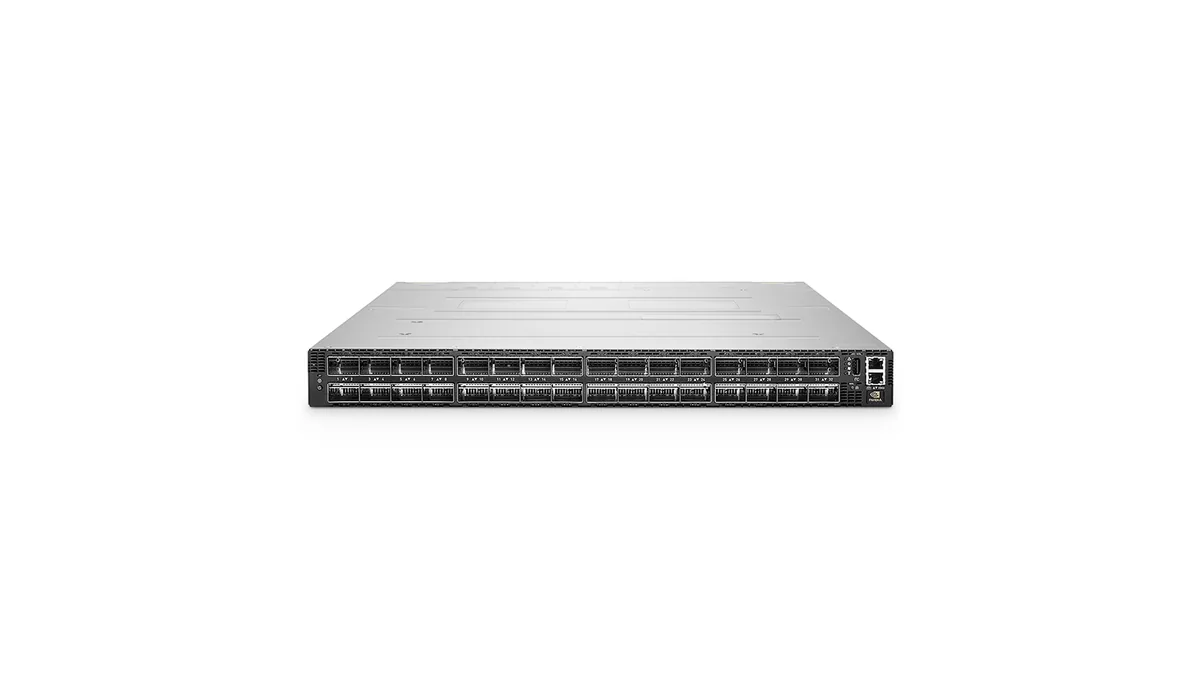
NVIDIA Quantum-2 and Quantum-X800 InfiniBand switch models. Managed and unmanaged options, spine and leaf configurations, authorised dealer supply.
The InfiniBand switch is the backbone of an HPC cluster: every MPI message and every gradient synchronisation between nodes passes through it. What sets it apart from Ethernet switching is not only speed but hardware-level flow control, which delivers lossless transport and sub-microsecond switching latency. At scale, that is what determines compute efficiency.
The NVIDIA Quantum-2 family runs at 400Gb/s NDR and the Quantum-X800 family at 800Gb/s XDR. Both come in managed and unmanaged variants; on managed models the subnet manager runs on the switch. SHARP technology aggregates part of the collective MPI operations inside the network — a gain that becomes more pronounced as node count grows in all-reduce heavy training jobs.
Mevasis treats the switch as part of the fabric rather than a standalone box: topology sizing, port planning, optics and cable selection, firmware alignment and commissioning tests are all part of the supply process.
How to choose
Managed or unmanaged?
On managed models the subnet manager runs on the switch itself; no separate management server is needed and telemetry comes straight from the switch. Unmanaged models cost less but require a subnet manager running somewhere in the fabric. As a rule of thumb: make the first switch managed, and choose unmanaged units as you scale out.
Speed tier: HDR, NDR or XDR?
The speed tier is set by your workload's communication profile, not by the GPU. Distributed training jobs doing heavy all-reduce benefit from NDR (400G) and above; for MPI-dominated classical simulation, HDR (200G) is usually enough. XDR (800G) is for deployments where per-port bandwidth is the bottleneck on Blackwell-class nodes.
Port count and topology
Size the port count against your target bisection bandwidth, not the node count. In a non-blocking fat-tree, half of every leaf switch's ports go to the spine — so 32 nodes need a 64-port leaf layer. Accepting a moderate blocking ratio lowers switch count and cost noticeably.
Cooling and physical layout
On high-density switches the airflow direction (port-to-power or power-to-port) must match your rack layout; the wrong direction breaks hot-aisle containment. Power draw and rack depth are also items to verify before ordering.
Products 1
Frequently Asked Questions
You can run OpenSM on a server inside the cluster, typically the login or management node. For production we recommend a redundant setup across two nodes. Installation and redundant configuration are covered by our commissioning service.
Different speed tiers can coexist in the same fabric; a link is established at the lowest common speed. In a mixed setup, topology and cabling planning become critical. Share your current inventory and we will produce a compatible part list and a migration plan.
The switch port and the server adapter port usually require different module types — for example a finned OSFP module on the switch side and a flat-top module on the HCA side. Our quote lists switch, adapter, optics and cable as a single compatibility-verified set.
Let's Build Future Together.