
NVIDIA Quantum QM8700 / QM8790 InfiniBand Switch
A 1U InfiniBand switch family with 40 x 200G HDR ports. QM8700 managed, QM8790 unmanaged; 16 Tb/s capacity, sub-130ns latency, SHARP supported.
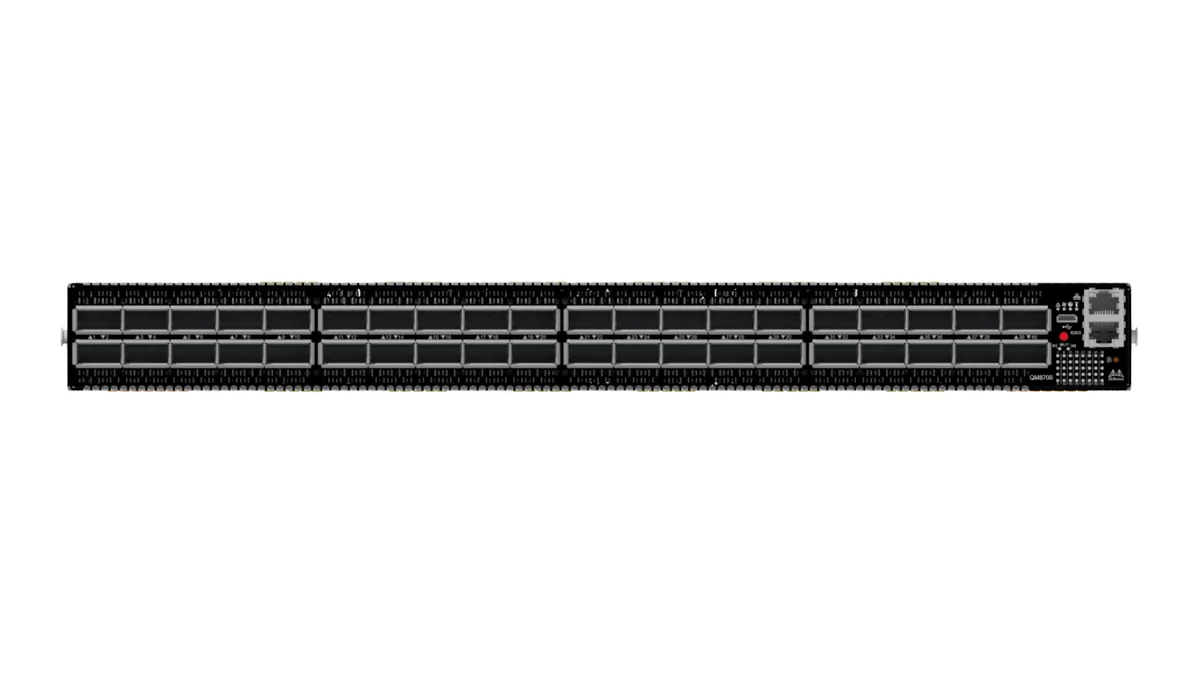
NVIDIA Quantum QM8700 / QM8790 InfiniBand Switch
A 1U InfiniBand switch family with 40 x 200G HDR ports. QM8700 managed, QM8790 unmanaged; 16 Tb/s capacity, sub-130ns latency, SHARP supported.
- 40 x 200Gb/s HDR QSFP56 ports — 80 x HDR100 with splitters
- 16 Tb/s switching capacity in a 1U chassis
- Sub-130ns port-to-port latency, 7.2 billion packets/s
- Onboard subnet manager for fabrics up to 2,000 nodes (QM8700)
QM8700 and QM8790 are 1U HDR switches built on the NVIDIA Quantum silicon. Both offer 40 ports of 200Gb/s QSFP56 and deliver sub-130 nanosecond port-to-port latency at 16 Tb/s of non-blocking capacity. The only difference is management: the QM8700 ships with an onboard subnet manager, while the QM8790 leaves management to an external subnet manager in the fabric.
The HDR generation still forms the backbone of most existing HPC clusters in Türkiye. Because 200Gb/s is usually sufficient for classic MPI-heavy simulation workloads, expanding the current HDR fabric can be markedly more economical than moving to NDR.
The QM8700’s notable capability is HDR100 support: 200G ports split into two separate two-lane 100G ports, connecting up to 80 nodes with ConnectX-6 adapters. In dense racks holding more than 40 servers, and in clusters that want to scale without moving to a three-level fat-tree, this halves the number of switches required.
Specifications
| Specification | QM8700 MQM8700-HS2F | QM8790 MQM8790-HS2F |
|---|---|---|
| Connectivity and capacity | ||
| Ports | 40 x HDR 200G (QSFP56) | 40 x HDR 200G (QSFP56) |
| With splitters | 80 x HDR100 100G | 80 x HDR100 100G |
| Switching capacity | 16 Tb/s | 16 Tb/s |
| Port-to-port latency | Sub-130ns | Sub-130ns |
| Packet rate | 7.2 billion packets/s | 7.2 billion packets/s |
| Management | Managed — CLI, WebUI, SNMP, JSON | Unmanaged — external subnet manager |
| Fabric capabilities | ||
| Onboard subnet manager (up to 2,000 nodes) | Yes | No |
| Adaptive routing | Yes | Yes |
| Congestion control | Yes | Yes |
| SHARP | Yes | Yes |
| VL2VL mapping | Yes | Yes |
| UFM agent | Yes | Yes |
| Virtual lanes (VL) | 9 (8 data + 1 management) | 9 (8 data + 1 management) |
| MTU | 256 B - 4 KB | 256 B - 4 KB |
| IBTA compliance | 1.21 and 1.3 | 1.21 and 1.3 |
| Physical and electrical | ||
| Chassis | 1U, 19" rack | 1U, 19" rack |
| Power supplies | 2 (1+1 redundant), hot-swap, 1100 W AC | 2 (1+1 redundant), hot-swap, 1100 W AC |
| Fans | N+1 redundant, hot-swap | N+1 redundant, hot-swap |
| Input voltage | 100-127 / 200-240 VAC, 50-60 Hz | 100-127 / 200-240 VAC, 50-60 Hz |
| Airflow | P2C (-HS2F) or C2P (-HS2R) | P2C (-HS2F) or C2P (-HS2R) |
| Operating temperature | 0-40 °C | 0-40 °C |
| Management ports | RJ45 100/1000, RS232, USB | RJ45 100/1000, RS232, USB |
Specifications follow the manufacturer datasheet. The exact configuration is confirmed in your quote.
Connectivity Solutions
Doubling port density with HDR100
The QM8700 can split each 200G port into two separate two-lane 100G ports. On servers with ConnectX-6 adapters that means one switch reaching 80 nodes — halving the switch count in dense racks with more than 40 servers and in mid-sized clusters that want to avoid a three-level fat-tree.
QSFP56 optics and cable selection
Passive copper DAC is used inside the rack, active optical cable or a QSFP56 transceiver plus trunk cable between racks. In a splitter configuration the cable type must match the port-split setting; we verify this in the quote.
Expanding an existing HDR cluster
When adding capacity to a running HDR fabric, the first switch is chosen managed (QM8700) and the ones added later unmanaged (QM8790). If a subnet manager is already running in the fabric, newly added switches need not be managed — which cuts the cost of expansion noticeably.
Features
Onboard subnet manager
The x86 CPU inside the QM8700 runs a subnet manager capable of handling fabrics up to 2,000 nodes. No separate management server is required; MLNX-OS provides full chassis management over CLI, WebUI, SNMP and JSON.
SHARP — collectives aggregated in the network
Part of MPI and SHMEM collective operations is reduced on the switch, so data does not travel repeatedly between endpoints. Large vector reductions are aggregated at wire speed, which benefits machine learning workloads directly.
Modern topology support
Static and adaptive routing, congestion control and enhanced VL mapping support SlimFly, Dragonfly+ and multi-dimensional torus topologies alongside fat-tree.
Bidirectional airflow option
The P2C (connector-side outlet) and C2P (connector-side inlet) variants are chosen according to how the switch faces inside the rack. The wrong direction breaks hot-aisle / cold-aisle containment — settle this together with the rack layout before ordering.
Resources
- QM8700 product brief (NVIDIA) Datasheet
- QM87xx hardware user manual Datasheet
- NVIDIA Quantum HDR InfiniBand platform Technical note
Documents open on the manufacturer's or supplier's own site.
Request a quote for this product
Tell us the quantity and the cluster it will join; we send a compatible part list with lead times — usually the same business day.
- Authorised dealer supply, manufacturer warranty
- Compatibility check for switch, adapter and optics
- Lead time per line item
Related products
 NVIDIA
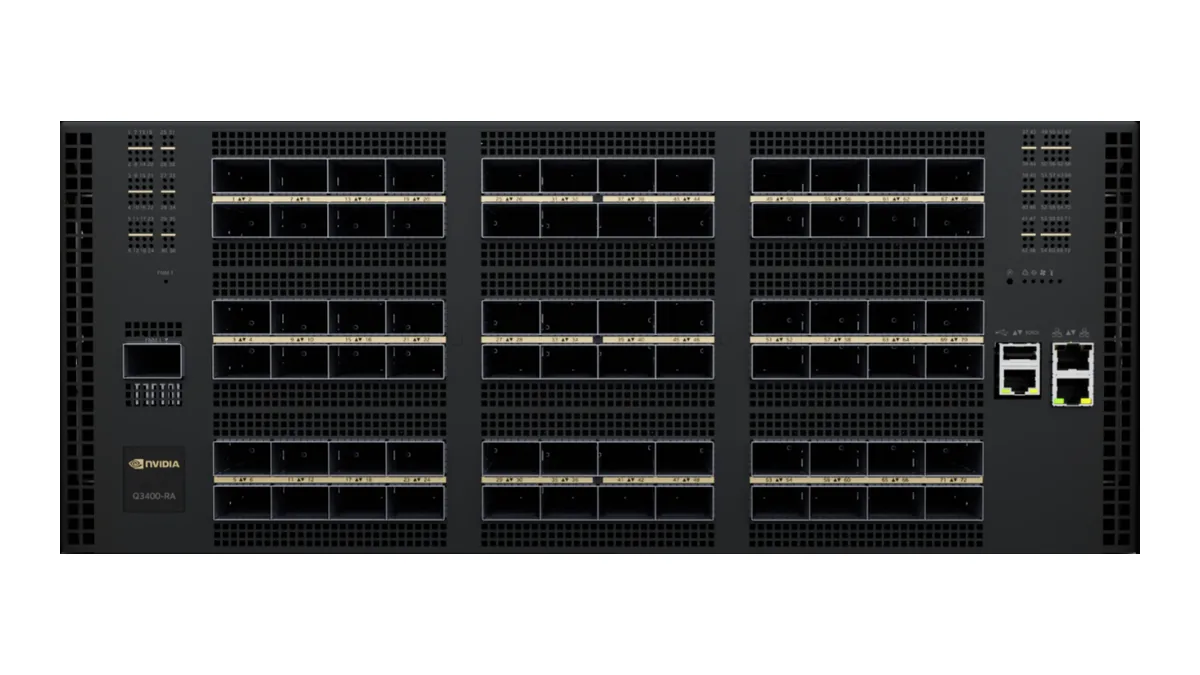
 Quantum-X800 Q3400-RA / Q3200-RA InfiniBand Switch
Q3400-RA: 144 x 800G XDR ports over 72 OSFP cages, 115.2 Tb/sQ3200-RA: 72 x 800G XDR ports over 36 OSFP cages, 57.6 Tb/s200Gb/s SerDes — double the per-lane rate
View details
Price on request
NVIDIA
NVIDIA Quantum-X800 Q3400-RA / Q3200-RA InfiniBand Switch
Q3400-RA: 144 x 800G XDR ports over 72 OSFP cages, 115.2 Tb/sQ3200-RA: 72 x 800G XDR ports over 36 OSFP cages, 57.6 Tb/s200Gb/s SerDes — double the per-lane rate
View details
Price on request
 NVIDIA
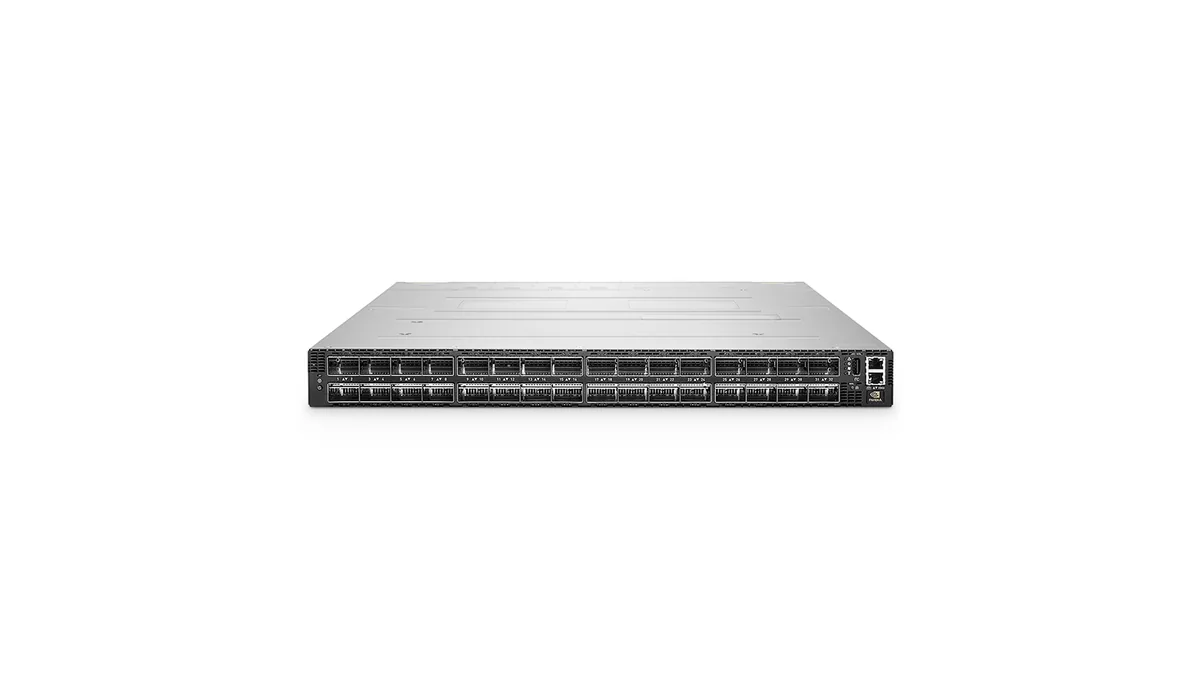
 Quantum-2 QM9700 / QM9790 InfiniBand Switch
64 x 400Gb/s NDR ports over 32 OSFP connectors25.6 Tb/s switching capacity in a 1U chassisSHARPv3 aggregates collective MPI operations inside the network
View details
Price on request
NVIDIA
NVIDIA Quantum-2 CS9500 Modular InfiniBand Switch
Up to 2,048 x 400G NDR ports in one chassis (or 4,096 x 200G)1,600 Tb/s aggregate bidirectional capacity29U modular chassis, liquid cooled
View details
Price on request
NVIDIA
NVIDIA Quantum-2 QM9700 / QM9790 InfiniBand Switch
64 x 400Gb/s NDR ports over 32 OSFP connectors25.6 Tb/s switching capacity in a 1U chassisSHARPv3 aggregates collective MPI operations inside the network
View details
Price on request
NVIDIA
NVIDIA Quantum-2 CS9500 Modular InfiniBand Switch
Up to 2,048 x 400G NDR ports in one chassis (or 4,096 x 200G)1,600 Tb/s aggregate bidirectional capacity29U modular chassis, liquid cooled
View details
Price on requestLet's Build Future Together.