
NVIDIA Quantum-X800 Q3400-RA / Q3200-RA InfiniBand Switch
800Gb/s XDR InfiniBand switch family. Q3400-RA 144 ports / 4U, Q3200-RA 72 ports / 2U; SHARPv4, adaptive routing and telemetry-based congestion control.
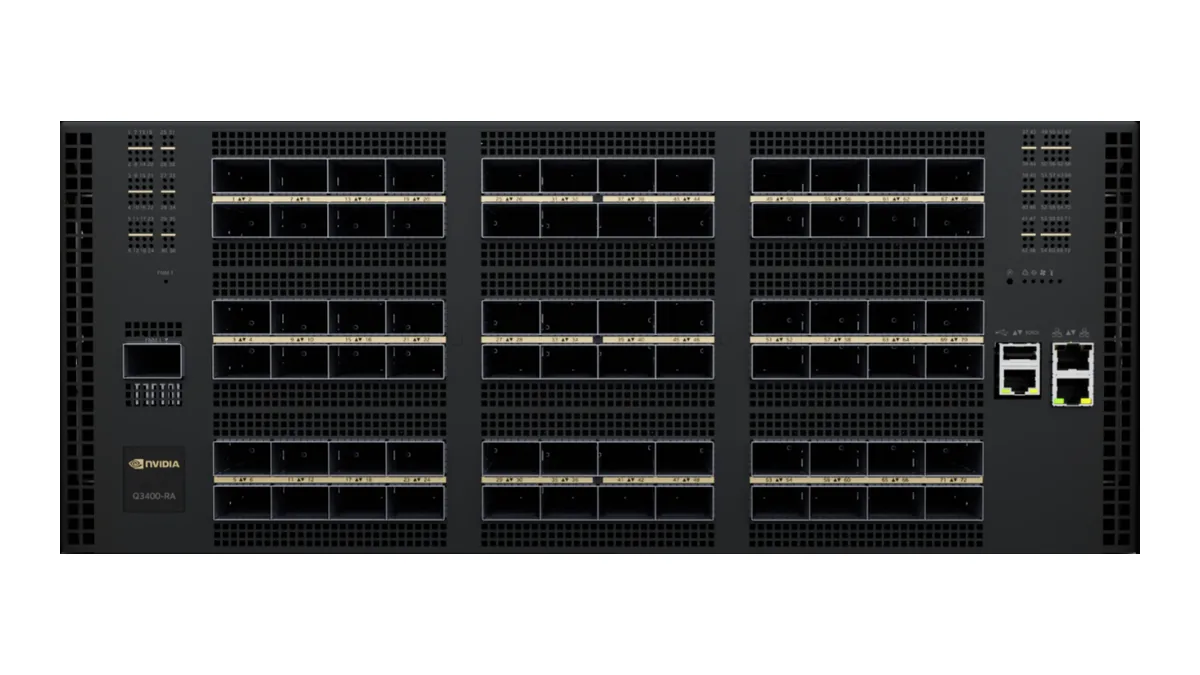
NVIDIA Quantum-X800 Q3400-RA / Q3200-RA InfiniBand Switch
800Gb/s XDR InfiniBand switch family. Q3400-RA 144 ports / 4U, Q3200-RA 72 ports / 2U; SHARPv4, adaptive routing and telemetry-based congestion control.
- Q3400-RA: 144 x 800G XDR ports over 72 OSFP cages, 115.2 Tb/s
- Q3200-RA: 72 x 800G XDR ports over 36 OSFP cages, 57.6 Tb/s
- 200Gb/s SerDes — double the per-lane rate
- SHARPv4 in-network collective computing
Quantum-X800 is NVIDIA’s 800Gb/s XDR generation. The difference is not only speed: with 200Gb/s SerDes per lane, per-port bandwidth doubles while the physical port count stays the same. In practice that means twice the capacity at the same cabling density.
The family has two air-cooled models. Q3400-RA delivers 144 ports of 800G over 72 OSFP cages in a 4U chassis — a radix high enough to gather more than 10,000 network adapters into a single fabric with a two-level fat-tree, removing the need for a third topology level. Q3200-RA brings the same generation down to 72 ports in a 2U chassis, suited to smaller installations and to the leaf layer.
The family also includes busbar-powered (Q3401-RD) and co-packaged-optics (Q3450-LD) variants, intended for installations whose rack and power architecture is designed around them. Which variant fits is assessed together with rack power distribution and cooling capacity.
One point deserves attention when planning power: the difference between passive and active cabling. The Q3400-RA draws a typical 2,900 W with passive copper, but reaches a maximum of 7,000 W in a fully active-optical configuration. Do not finalise the rack power budget before the cable type is settled.
Specifications
| Specification | Q3400-RA | Q3200-RA |
|---|---|---|
| Connectivity and capacity | ||
| Ports | 144 x XDR 800G (72 OSFP cages) | 72 x XDR 800G (36 OSFP cages) |
| Switching capacity | 115.2 Tb/s | 57.6 Tb/s |
| Chassis | 4U, 19" rack | 2U, 19" rack |
| Connector | OSFP | OSFP |
| Fabric capabilities | ||
| SHARPv4 (in-network collectives) | Yes | Yes |
| Adaptive routing | Yes | Yes |
| Telemetry-based congestion control | Yes | Yes |
| Performance isolation | Yes | Yes |
| Dedicated UFM port | Yes | Yes |
| Physical and electrical | ||
| Dimensions (H x W x D) | 177.8 x 438 x 850 mm | 88 x 438 x 680 mm |
| Weight | 60 kg (with 8 PSUs) | 49 kg |
| Power supplies | 8, replaceable | 4, replaceable |
| Fans | 10 | 5 |
| Input voltage | 200-240 VAC, 10 A, 50/60 Hz (per PSU) | 200-240 VAC, 10 A, 50/60 Hz (per PSU) |
| Typical power (passive cables) | 2,900 W | 862 W |
| Max power (active cables) | 7,000 W | 3,486 W |
| Airflow | Reverse | Reverse |
| Operating temperature | 0-35 °C | 0-35 °C |
Specifications follow the manufacturer datasheet. The exact configuration is confirmed in your quote.
Connectivity Solutions
XDR spine and leaf layers
The 144-port radix of the Q3400-RA is enough to gather more than 10,000 network adapters into a single fabric with a two-level fat-tree. Because no third topology level is needed, both latency and the number of spine switches drop. The Q3200-RA brings the same generation to smaller installations and to the leaf layer.
Optics and cabling
At the XDR tier links are built over OSFP cages; passive copper DAC is used at short reach and active optics between racks. Active cables raise switch power draw substantially — finalise the power and cooling plan only after the cable type is decided.
Management and telemetry
The system runs NVOS and provides a dedicated management port for UFM. Fabric telemetry feeds the congestion-control decisions, reducing the variance in job completion times under heavy collective traffic.
Features
Double the lane rate with 200Gb/s SerDes
Quantum-X800 signals at 200Gb/s per lane. That means twice the bandwidth at the same port count: per-port throughput reaches 800Gb/s without increasing the number of cables and optics.
SHARPv4
In-network aggregation of collective MPI operations moves to its fourth generation. For all-reduce heavy distributed training, the benefit grows with the node count.
Telemetry-based congestion control
Congestion is managed from live fabric telemetry rather than fixed thresholds. Performance isolation keeps jobs sharing the same fabric from disturbing each other's completion times.
High radix, shallower topology
144 ports reach more than ten thousand endpoints in a two-level fat-tree. Dropping the third level cuts both end-to-end latency and the total cost of switches and optics.
Resources
- NVIDIA Quantum-X800 platform page Technical note
- Q32xx / Q34xx XDR switch hardware manual Datasheet
- XDR switch specifications Datasheet
Documents open on the manufacturer's or supplier's own site.
Request a quote for this product
Tell us the quantity and the cluster it will join; we send a compatible part list with lead times — usually the same business day.
- Authorised dealer supply, manufacturer warranty
- Compatibility check for switch, adapter and optics
- Lead time per line item
Related products
 NVIDIA
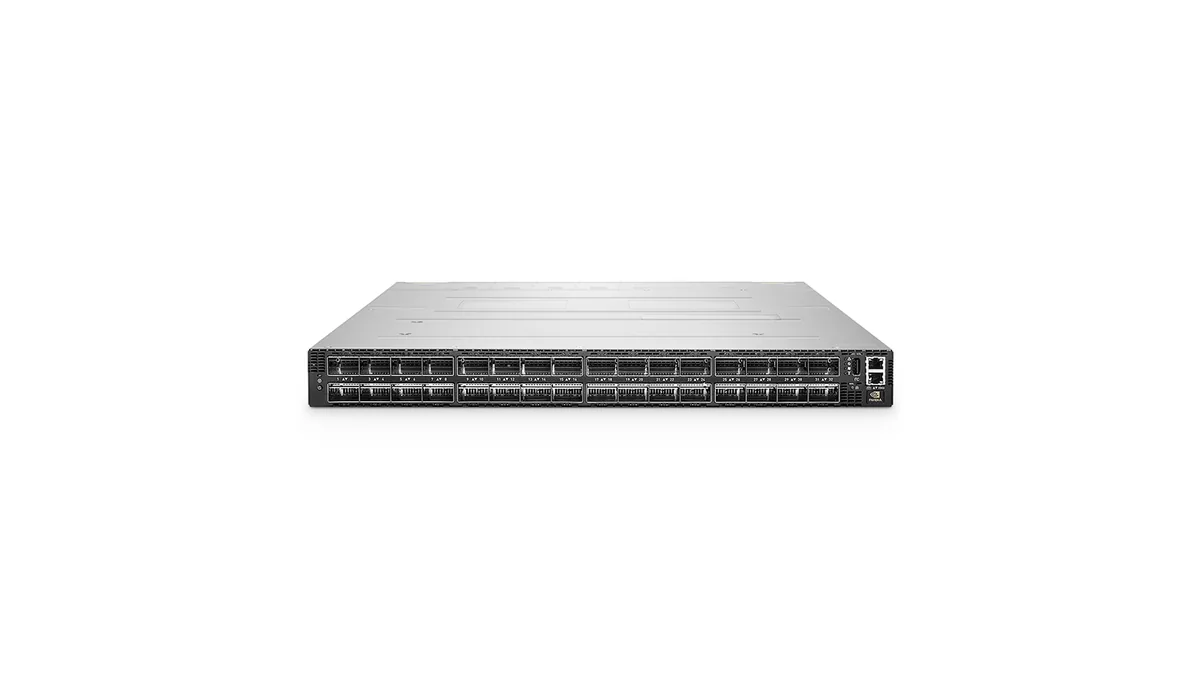
 Quantum-2 QM9700 / QM9790 InfiniBand Switch
64 x 400Gb/s NDR ports over 32 OSFP connectors25.6 Tb/s switching capacity in a 1U chassisSHARPv3 aggregates collective MPI operations inside the network
View details
Price on request
NVIDIA
NVIDIA Quantum-2 CS9500 Modular InfiniBand Switch
Up to 2,048 x 400G NDR ports in one chassis (or 4,096 x 200G)1,600 Tb/s aggregate bidirectional capacity29U modular chassis, liquid cooled
View details
Price on request
NVIDIA
NVIDIA Quantum-2 QM9700 / QM9790 InfiniBand Switch
64 x 400Gb/s NDR ports over 32 OSFP connectors25.6 Tb/s switching capacity in a 1U chassisSHARPv3 aggregates collective MPI operations inside the network
View details
Price on request
NVIDIA
NVIDIA Quantum-2 CS9500 Modular InfiniBand Switch
Up to 2,048 x 400G NDR ports in one chassis (or 4,096 x 200G)1,600 Tb/s aggregate bidirectional capacity29U modular chassis, liquid cooled
View details
Price on request
 NVIDIA
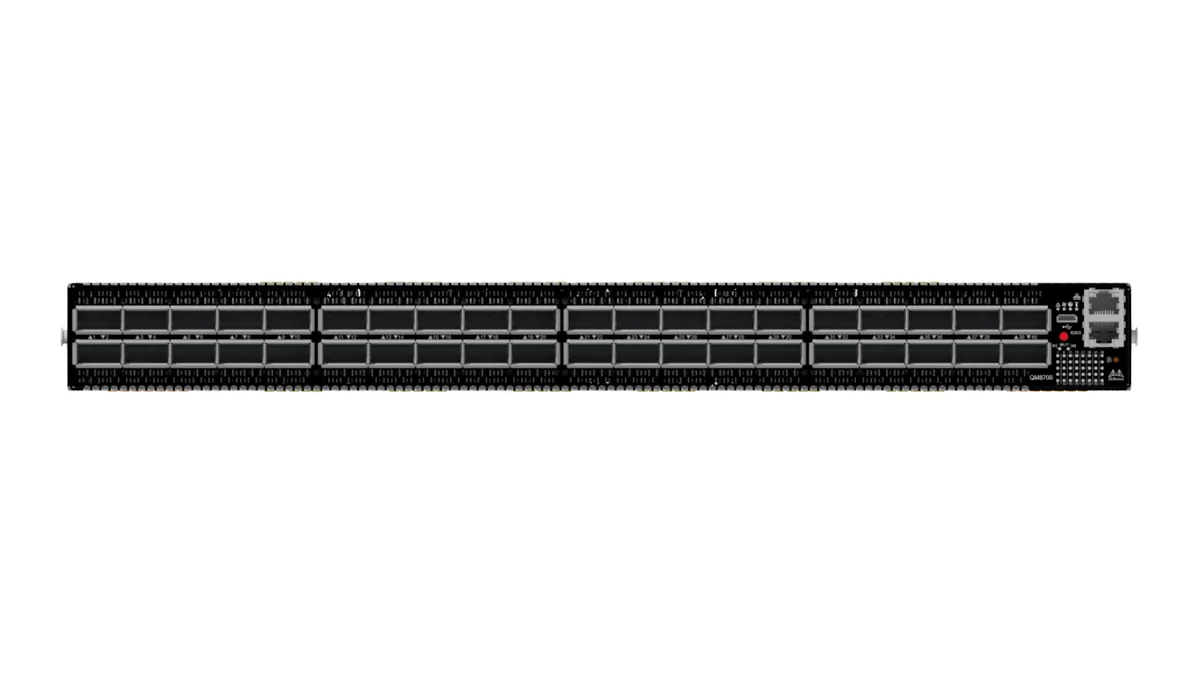
 Quantum QM8700 / QM8790 InfiniBand Switch
40 x 200Gb/s HDR QSFP56 ports — 80 x HDR100 with splitters16 Tb/s switching capacity in a 1U chassisSub-130ns port-to-port latency, 7.2 billion packets/s
View details
Price on request
NVIDIA
NVIDIA Quantum QM8700 / QM8790 InfiniBand Switch
40 x 200Gb/s HDR QSFP56 ports — 80 x HDR100 with splitters16 Tb/s switching capacity in a 1U chassisSub-130ns port-to-port latency, 7.2 billion packets/s
View details
Price on requestLet's Build Future Together.